Laser Engraver for Metal: Match Mark to Source
Updated September 14, 2026
Before you choose a laser engraver for metal, write the exact metal, whether the mark is direct in the metal or only through a coating or anodized layer, the permanence you need, part size, and production volume. Different laser sources interact with metals differently, so a generic “metal capable” label is not a buying spec. Manufacturer fiber systems are sold for marking and engraving metals such as stainless steel, aluminum, tool steel, brass, titanium, copper, silver, gold, and iron, and the fiber source is described with a wavelength suited to etching metal (Epilog Laser metal marking; OMTech fiber laser machines). Require a written process match and a sample on your part before you shortlist machines.
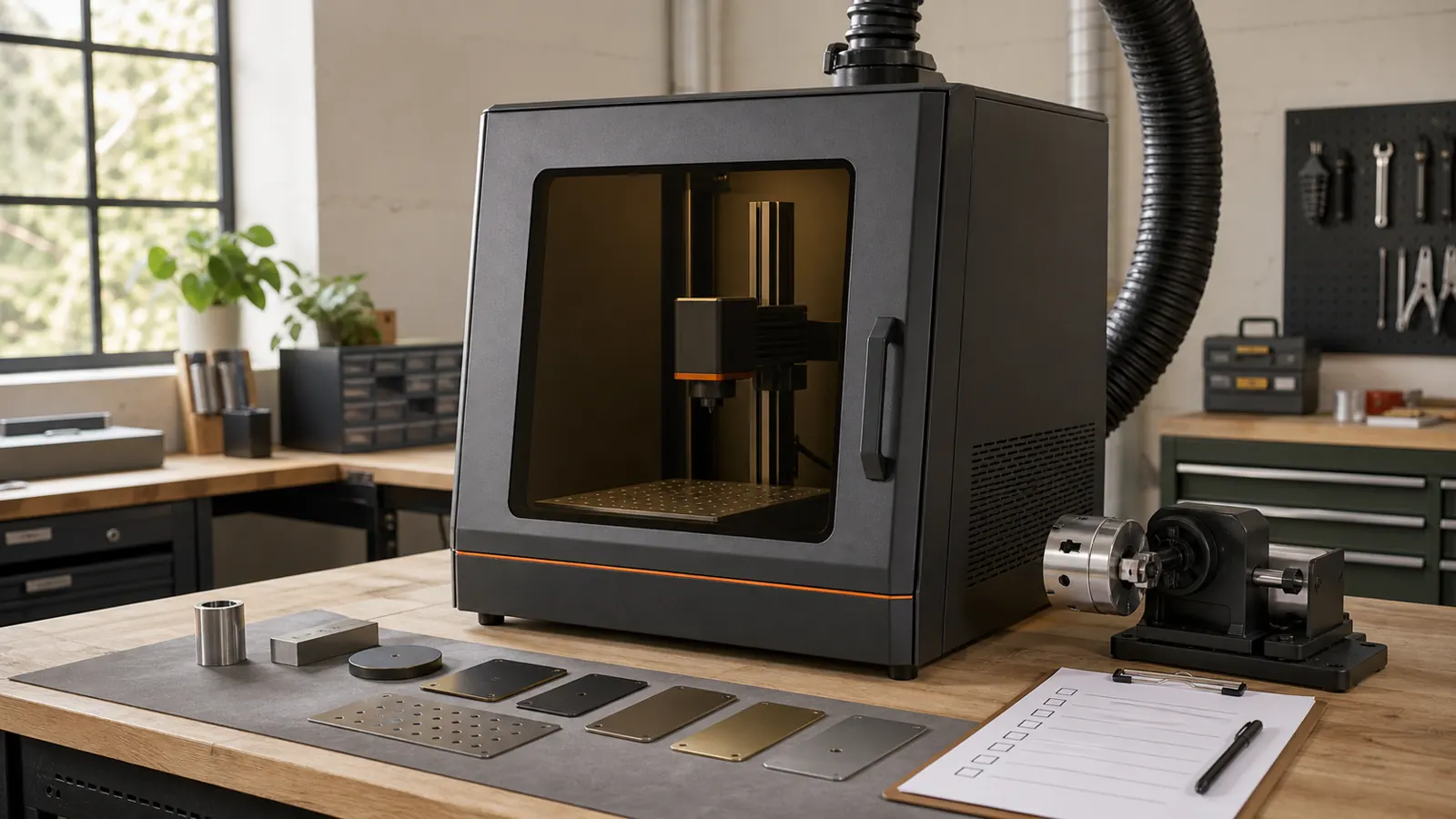
Our view: specify the metal and the mark first, then prove the source on that job.
What kind of laser engraver do I need for metal?
Start with the part, not the product page. “Metal” is not one material. Record the alloy or grade when known, the surface finish, and any coating, plating, paint, or anodized layer. Separate the required result into clear jobs: a readable ID, a logo, a recessed engraving, or another defined mark. Marking, engraving, and cutting are not interchangeable claims on a sales sheet.
Fiber metal-marking machines are presented for barcodes, serial numbers, text, and logos on metal, and for creating a variety of mark types on the metals listed by the manufacturer (Epilog Laser metal marking). Fiber product lines are also sold for etching and engraving metal materials in workshop and production settings (OMTech fiber laser machines). Dual-source designs that combine a CO2 source and a fiber source are described as a way to widen the materials and processes one machine can address when both sources are installed and supported (Epilog Laser metal marking).
That still does not make every “metal” listing equal. Ask each seller to name the laser source, the process (mark, engrave, or cut), and the exact finish on your part. Keep a job card that two vendors can quote against the same inputs. Our fiber laser engraver buyer gate walks the sample-and-safety file once fiber is on the shortlist. For non-metal or mixed organic work that may need another source, see the CO2 laser engraver readiness guide.
When UV also appears on a metal-marking quote, use the UV laser engraver guide to demand a model-specific sample rather than reading a category claim as proof for your alloy and finish.
- Exact metal: alloy or grade, thickness range, and supplier notes when available.
- Surface condition: bare, coated, painted, plated, or anodized, stated without guessing.
- Mark intent: identification, logo, recess, or another acceptance description you can inspect.
- Part geometry: flat, curved, clearance limits, and whether a fixture or rotary path is required.
- Volume and changeover: single parts, jigs of many parts, or mixed batches with recorded load steps.
Is a coated or anodized mark the same as direct metal marking?
No. Treat a mark that only changes a coating or anodized layer as a different job from a mark made in the metal itself. The acceptance criteria change: contrast on a coating is not the same proof as a permanent mark in the substrate. Do not let a demo on painted scrap stand in for bare stainless, and do not let a bare coupon stand in for your coated production part.
Write the difference into the RFQ:
- whether the laser must interact with the coating or anodized layer only;
- whether the laser must mark or engrave the underlying metal;
- how you will inspect permanence, contrast, and edge quality on the real finish;
- which sample is rejected if the finish on the test piece does not match production stock.
Manufacturer metal lists name metals such as stainless steel, aluminum, brass, titanium, and copper for fiber marking and engraving. They do not replace a finish-specific sample on your coated or anodized part (Epilog Laser metal marking). If the seller cannot state which layer the process changes, stop the comparison until that answer is written.
| Buyer input | Question to lock | Evidence to request | Reject signal |
|---|---|---|---|
| Metal identity | Is the alloy or grade named? | Material declaration plus a marked sample on that metal | Generic “works on metal” claim only |
| Finish stack | Is the mark on a coating, anodize, or bare metal? | Sample on the production finish, not a stand-in scrap | Demo finish differs from the real part |
| Required permanence | What must still be readable after your stated use? | Written acceptance description and approved reference mark | Words such as “permanent” with no inspection rule |
| Part size and access | Can the quoted field, doors, and fixture reach the mark zone? | Setup photo or live load with representative geometry | Hand-held workarounds left unexplained |
| Production volume | Is the workflow single-piece, jigged batches, or mixed changeovers? | Full cycle with load, job select, and first-piece check | Video of one easy part only |
| Laser source | Is the source named for this metal and process? | Manufacturer materials statement for the quoted source | “Metal capable” without source or process |
Before you turn the job card into a shortlist, run the picker. Use it to structure questions. It does not replace a sample on your metal.
What is the best laser engraver machine for metal?
There is no universal winner on this keyword. Catalog pages and ranked lists cannot see your alloy, coating stack, mark depth, fixture, or batch size. The stronger buying pattern is a needs matrix tied to proof:
- Job card complete for metal, finish, mark, size, and volume.
- Source and process named in writing for that job.
- Sample produced with the quoted hardware, lens or field, fixture, and software path.
- Safety and facility review planned for the exact machine and site (OSHA Laser Hazards).
- Support path named: manuals, warranty contact, training, and spare parts route.
Fiber flatbed and galvo metal-marking systems are offered for single parts and for jigs that hold many parts in one run. Rotary options are described for cylindrical metal parts when the matching attachment is quoted and demonstrated (Epilog Laser metal marking). MOPA fiber configurations are marketed for metal marking tasks that the seller ties to color or deeper engraving on supported machines (OMTech fiber laser machines). Treat those as product-line statements. Confirm them on your part before you call any machine “best.”
If two machines both clear the sample gate, compare the full scope: enclosure and access behavior, usable field, fixture package, software license, startup, and service. Do not collapse unlike risks into one score.
How powerful of a laser is needed to engrave metal?
A wattage sticker is not a metal-marking specification. Power figures on a product card do not, by themselves, define which alloy will mark, how a coated finish will respond, what contrast you will accept, or whether the fixture and field can reach the mark zone.
What manufacturers do publish is source and configuration detail you can verify:
- A fiber laser source is described as creating a beam at 1062 nm, presented as suited to etching metal and marking plastic (Epilog Laser metal marking).
- Fiber metal-marking product lines list discrete wattage configurations (including MOPA options such as 30 W, 60 W, and 100 W on named platforms) as machine builds, not as a universal “watts required for metal” rule (Epilog Laser metal marking; OMTech fiber laser machines).
- Deep engraving and color-oriented metal work are marketed on specific MOPA fiber offerings; those claims still need a sample on your metal and finish (OMTech fiber laser machines).
When a seller leads with watts, ask for the process recipe they will use on your metal, the expected mark definition in writing, and a retained sample. If they will not run your finish, do not infer capability from a higher number on a different alloy.
How much does a laser engraving machine for metal cost?
This page does not restate list prices or invent a budget band. Public storefronts and manufacturer request forms change, and a headline machine price rarely equals the installed cost of a metal-marking cell.
Build a current ownership record instead:
- quoted laser source, field or lens package, and any dual-source option;
- fixtures, jigs, and rotary hardware required for your parts;
- software, computer, training, and startup responsibilities;
- shipping, siting, electrical, and any maker-required installation conditions;
- service channel, warranty terms, and consumable or spare path named in writing.
Ask for an itemized quote against the same job card you used for samples. If a line item is missing, mark it missing. Do not fill gaps with prices copied from another model or another year.
Is it worth buying a laser engraving machine?
Buying is worth considering when metal marking is a repeat job you can define, fixture, and inspect, and when the sample-and-safety file is complete. It is not worth forcing a purchase when the metal finish is still unknown, when only a video of a different alloy exists, or when the site controls for the exact machine are unwritten.
Use this gate:
- The metal, finish stack, and mark acceptance rules are written.
- A sample on that job is approved and retained.
- The laser source and process are named for that sample.
- Part size, fixture, and volume workflow are demonstrated.
- Laser hazard controls for the installation are planned with the maker documents and applicable workplace rules (OSHA Laser Hazards).
If any gate fails, keep using a marking service or revise the brief. A machine that cannot prove your mark is not a bargain at any quote.
What laser safety facts belong in the purchase file?
LASER means Light Amplification by Stimulated Emission of Radiation. A laser produces an intense, highly directional beam of light. The most common cause of laser-induced tissue damage is thermal: tissue proteins are denatured from the temperature rise after absorption of laser energy (OSHA Laser Hazards).
The human body is vulnerable to the output of certain lasers, and under certain circumstances exposure can damage the eye and skin. The human eye is almost always more vulnerable to injury than human skin. Laser hazards are addressed in specific OSHA standards for general industry (OSHA Laser Hazards).
Put these items in the purchase file before delivery day:
- manufacturer manuals, labels, and intended mode of use for the exact configuration;
- who performs the competent laser-safety and site review for this machine and process;
- how beam and non-beam hazards for the approved metals will be controlled under the rules that apply to your workplace;
- training, authorization, and incident response named for operators;
- a clear rule that unknown metals and finishes are not test stock without documentation.
Do not invent protective equipment, ventilation recipes, or power settings in place of the maker documents and the site review. OSHA points to standards, hazard recognition, and possible solutions. It does not replace the machine manual for your model (OSHA Laser Hazards).
What are the key takeaways?
- Specify exact metal, coating versus direct mark, permanence, part size, and volume before comparing machines.
- Treat a generic “metal capable” label as incomplete; name the laser source and process.
- Fiber manufacturer materials lists cover many metals used for marking and engraving, and still require a sample on your finish (Epilog Laser metal marking; OMTech fiber laser machines).
- Wattage and catalog rank are not substitutes for an approved sample and a written safety plan (OSHA Laser Hazards).
What belongs on the pre-order checklist?
- Exact metal and finish stack are recorded, including coating or anodize when present.
- Direct metal mark versus coating-layer mark is stated without overlap.
- Permanence and inspection rules are written and tied to a reference sample.
- Part size, fixture, field access, and volume workflow are demonstrated.
- Laser source and process are named for the approved sample.
- Manufacturer materials statement matches the quoted configuration.
- Itemized quote lists source, fixtures, software, startup, and support path.
- Competent laser-safety and facility review is planned for the exact installation (OSHA Laser Hazards).
What else do buyers ask?
What kind of laser engraver do I need for metal?
Name the exact metal and finish, whether the mark is direct in the metal or only through a coating or anodized layer, the permanence you need, part size, and production volume. Then require written process proof on that part. A generic metal-capable label is not enough because laser sources interact with metals differently.
What is the best laser engraver machine for metal?
There is no single best machine without a defined job. Compare machines that can prove the required mark on your metal and finish, with the fixture, field, software, and safety controls you will actually use. Use manufacturer materials lists and a sample on your part, not a catalog ranking.
How much does a laser engraving machine for metal cost?
This guide does not restate machine prices. Ask sellers for a current itemized quote for the exact source, field, fixtures, software, startup, training, and any dual-source options you need, then add the site controls required for your installation.
How powerful of a laser is needed to engrave metal?
Do not buy from a wattage number alone. Manufacturer fiber lines list specific configurations for metal marking, and the fiber source wavelength is described as suited to etching metal, but your proof is a sample on the exact metal and mark. Wattage does not replace material, finish, and process evidence (Epilog Laser metal marking).
Is it worth buying a laser engraving machine?
It is worth buying only when the metal job is defined, a sample on that job is approved, and the safety and facility plan for the exact machine is written. If the mark is rare, undefined, or unproven, keep the work with a service until those gates pass.
Ready to turn the metal job card into a shortlist? Run the picker, then open the Make At Home homepage for the wider machine path. Send the same requirements to every seller with your sample and safety questions.
Written by Tileo, operator of Make At Home.