CO2 Laser Engraver: The Workshop Readiness Gate
Short answer: A CO2 laser engraver is worth considering only after you can evidence the exact material and job, current machine documentation, enclosure and interlocks, exhaust route, cooling, power, space and access, fire response, software and service, and active supervision. OSHA identifies eye, skin, fire, electrical and collateral laser hazards, with controls based on classification and use (OSHA). LBNL provides information about engineering controls, administrative controls and training (LBNL). This article's conservative editorial gate is simple: if any field is unknown, do not shortlist a machine or run a test. Revise the facility plan, use a service, or stop.
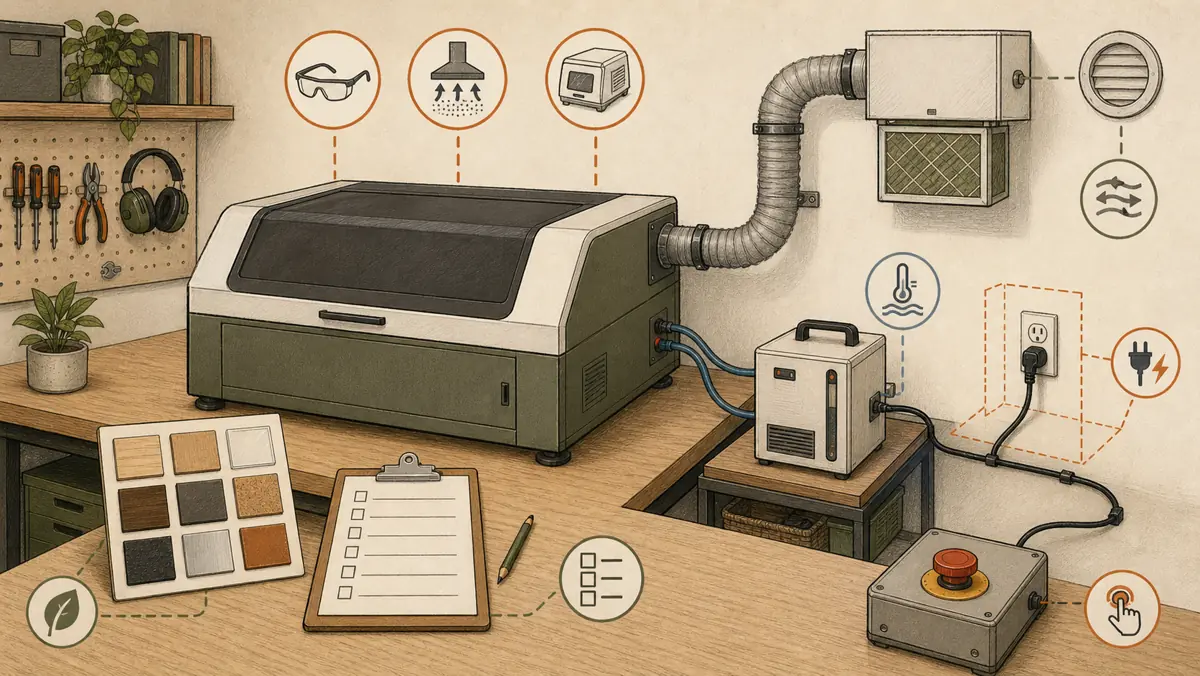
Is a CO2 laser engraver worth it for your workshop?
“Worth it” is a fit decision here. It is not a payback claim. The machine has to fit one defined job. It also has to fit the real room. No projected profit can replace those facts. Nor can a claim about revenue or saved time. The job may be occasional. The room may not meet the written needs. In either case, a service can remain the better route for that brief.
The safety part is not a generic checklist. OSHA says controls depend on the laser class and use. It describes eye and skin hazards. It also covers fire, electrical and other hazards (OSHA). LBNL provides information about engineering controls, administrative controls and training (LBNL). This page cannot replace the exact manual. It also cannot replace a skilled local check.
Before browsing models, compare this route with the wider desktop laser cutter workflow guide and frame the full purchase in the laser buying planner.
What belongs in the job and material brief?
Begin with a single item to make. The gate needs a stock ID you can trace. It needs the planned task. It also needs a pass or fail check. Before any work, get the machine maker's current material guide. Get the material supplier SDS too. A broad label does not close this field. “Plastic,” “wood” and “coated sheet” are broad labels.
- Editorial brief: record product or grade, supplier, finish, coating, treatment, thickness and batch identity.
- Editorial brief: state whether the job is a mark, engraving or cut, plus the required usable area and access.
- Editorial brief: save the current machine manual, compatibility guidance and supplier SDS with dates or revision identifiers.
- Editorial brief: define what an acceptable sample must show without assuming a result from different stock or a different configuration.
A sample on unknown stock is not evidence for your job. A sample from another setup is not evidence either. The machine maker must give current written support. The material supplier must do the same. That support must cover the exact mix. If it does not, this gate marks the field “stop.”
What is the complete facility gate?
Read the product label and class. Then read the exact current manual. Use the planned task to identify the controls. OSHA ties controls to class and use. It does not give one workshop recipe for all lasers (OSHA). LBNL provides information about engineering controls, administrative controls and training (LBNL).
| Facility field | Evidence required by this editorial gate | Decision if open |
|---|---|---|
| Machine and use | Exact configuration, label/classification, current manual and intended job. OSHA says controls depend on classification and use (OSHA). | Do not shortlist. |
| Enclosure and interlocks | Current manufacturer description of the enclosure, interlocks and access controls for that configuration. | Never bypass; stop. |
| Exhaust route | Exact machine and material requirements plus a complete facility route confirmed by a competent or local assessment. | Do not test. |
| Cooling | Current requirements for the exact configuration and evidence that the complete setup can meet them. | Do not test. |
| Power and site work | Manufacturer requirements mapped to the actual site by a competent or local assessment. | Revise the facility plan. |
| Space and access | Machine, stock, doors or lids, cooling, exhaust, service access and the access controls required by the manual. | Revise or stop. |
| Fire response | The exact current manufacturer stop and emergency procedure, active supervision and a competent or local assessment. OSHA identifies fire as a laser hazard (OSHA). | Do not test. |
| Software and service | Supported system and file path, updates, warranty, parts, maintenance and a named service route. | Keep the field open. |
What should not be processed?
This guide has no universal banned-material list. Its cautious rule is narrow. It is also easy to audit. Get the exact machine maker's current material guide. Get the material supplier SDS. Both must cover the planned task.
- Stop: the stock identity is unknown.
- Stop: a composite, coating or chemical treatment lacks current written compatibility evidence.
- Stop: the documentation covers a different finish, operation, thickness or machine configuration.
- Stop: a common name is the only support for a claim that the material can be processed.
A common name does not prove a stock is safe. Do not transfer a sample result from unknown stock. These are editorial stop rules. They do not replace the machine maker. They do not replace the supplier or a skilled check.
How should you compare CO2 and diode lasers?
There is no winner for every job. Put the same job card by each exact machine. Check the written material support. Check the task, controls and site needs. Then check upkeep and service. Tie each claim to that setup. “CO2” and “diode” are not full specs.
For a diode route, use the diode laser engraver evidence worksheet. For both routes, tie the enclosure to class and use. Do the same for locks, access and the hazard check. OSHA uses that approach (OSHA). Do not use claims with no source. Claims about speed, materials or output are not shortcuts.
What does a CO2 laser engraver cost to own?
This guide gives no prices or ranges. Cost is a set of evidence fields here. Each field must fit the exact machine and room. Get written quotes when you decide. Get current needs and service terms too. Do not turn the total into a sales forecast. It is not a payback forecast either.
| Ownership field | What to record | Evidence status |
|---|---|---|
| Machine/configuration | Exact included configuration, required options, delivery and installation scope. | Quoted / open |
| Extraction | Specified equipment, complete route, site preparation and ongoing consumables. | Documented / open |
| Cooling | Required system, installation, maintenance and replacement items. | Documented / open |
| Power/site preparation | Assessment, required work and access changes for the actual room. | Assessed / open |
| Software | Licences, supported systems, updates and file workflow. | Confirmed / open |
| Consumables and maintenance | Manufacturer schedule, parts, cleaning items and service tasks. | Current / open |
| Parts and service | Warranty, exclusions, response route, parts supply and service responsibility. | Written / open |
| Training and testing | Required instruction, supervised evidence runs and material used for permitted tests. | Planned / open |
| Waste handling | Material-specific compliant handling route confirmed for the location. | Confirmed / open |
An open cost line is not zero. It stays open until proof exists. Use the laser buying planner to hold this record. Do that before you compare named models.
What evidence is needed before a first test?
This gate allows a first test only after proof is complete. Current documents must cover the exact stock. They must cover the task and setup too. Close every control, exhaust and cooling field. Record active watch and the maker's current stop steps. OSHA lists laser and related hazards. It bases controls on class and use (OSHA). LBNL provides information about engineering controls, administrative controls and training (LBNL).
- Editorial record: identify the stock, SDS, machine configuration and document revisions.
- Editorial record: confirm the required controls, exhaust, cooling, power, access and supervision evidence.
- Editorial record: use only the exact current manufacturer procedure and its stop criteria.
- Editorial record: log the result and any stop without converting it into advice for another stock or setup.
A result does not approve a material group. It covers only the stock in the log. It covers only that setup. It also covers only the allowed steps in that log.
Should you buy, use a service, or stop?
Buy and compare only when all fields have proof. That means the job and stock. It also means the room, controls, cost and service. Each field must fit the exact setup. This is leave to compare. It is not a call to buy.
Revise or use a service when the job is sound but the room is not. The cost plan may not work either. Give the service the same exact stock brief. Give it the same pass or fail check. Outsourcing does not prove unknown stock will work.
Stop when the stock is unknown. Stop when written fit is absent. Stop for a bypassed control. Stop when exhaust or cooling proof is missing. Stop if the test would run alone. The wider machine categories can help you rethink the process. They do not force a laser choice.
CO2 laser engraver FAQ
Is a CO2 laser engraver worth it?
It is worth considering only when the exact job and material, current machine documents, controls, exhaust, cooling, power, space, fire response, software, service and active supervision are evidenced. Otherwise revise the facility plan, use a service or stop.
What is the downside of a CO2 laser engraver?
The decision includes the facility and operating system, not just the machine. Extraction, cooling, power and site preparation, controls, software, consumables, maintenance, parts, service, training, testing and waste handling all need evidence.
How much does a CO2 laser engraver cost?
This guide publishes no estimate. Record current evidence for the exact configuration and every row in the ownership table. An unresolved row remains open rather than becoming zero.
Can a CO2 laser engraver process my material?
Only current guidance for the exact machine and operation, plus the material supplier SDS, can close that field in this editorial gate. Unknown, composite, coated or chemically treated stock without current written compatibility evidence is a stop condition.
What should not be engraved?
Do not rely on a universal list or a common material name. Stop when identity or current written compatibility evidence is missing, and do not transfer a sample from other stock or another configuration.
Ready to map the process to your room? Open the machine picker
Written by Tileo, operator of Make At Home.