3D Printer Filament Storage: A Practical System for Every Spool
The right 3D printer filament storage setup is a sealed bag or container with desiccant for an opened spool that still prints normally. Add a humidity indicator so you can see whether the container is maintaining its internal condition. If a spool already shows moisture-related print problems, storage is not the same as drying. Use a purpose-built filament dryer and follow the filament maker's and dryer maker's instructions. Prusa recommends a closed space or box with desiccant for prevention. Bambu Lab says dried filament should return to a sealed container or compatible material system with effective desiccant (Prusa drying guide, Bambu Lab drying guidance).
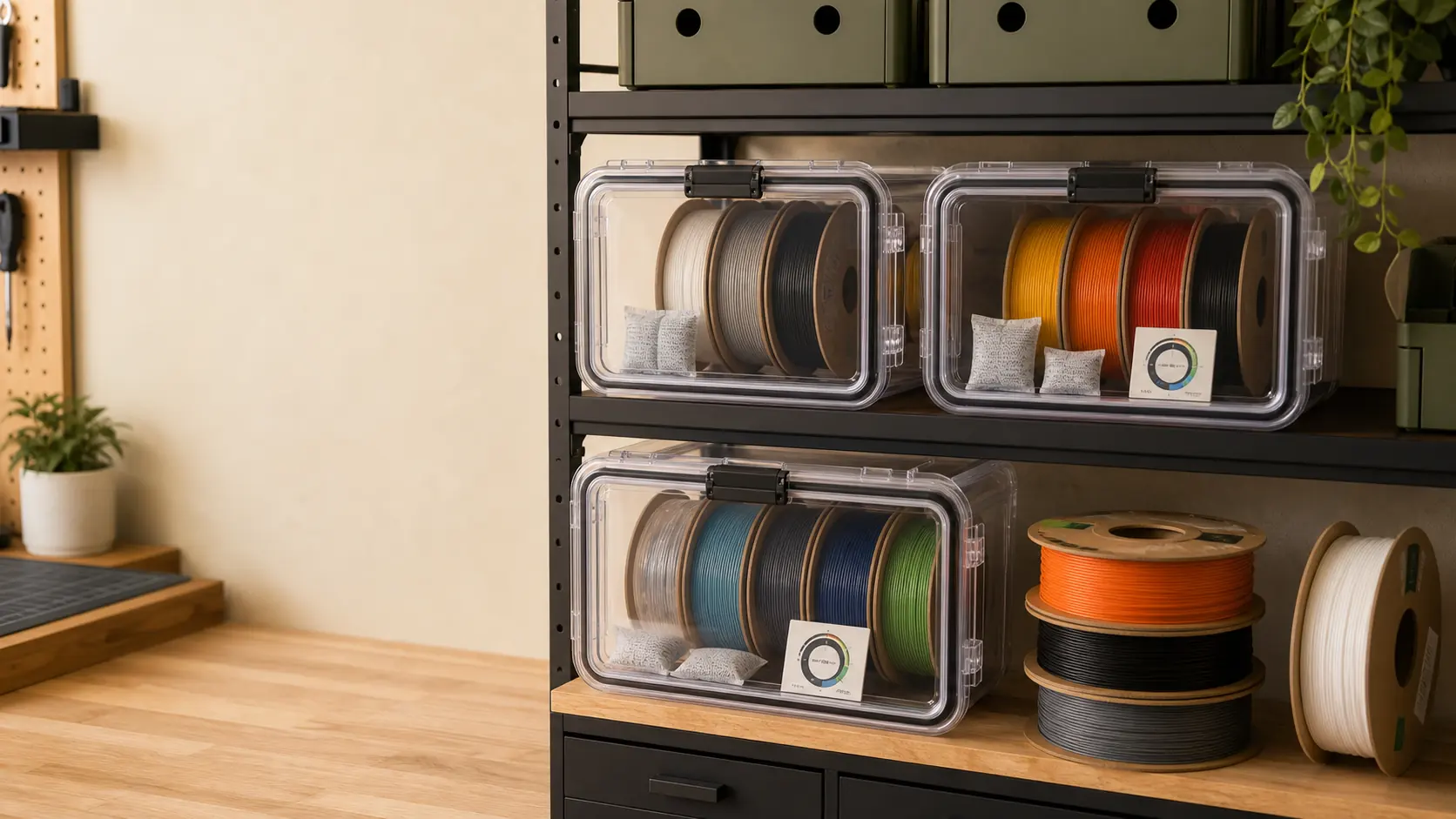
Choose by condition and workflow. One spool can live in a resealable bag. Several frequently used spools fit a gasketed bin. A feed-through dry box suits printing without removing a protected spool. A dryer is for active moisture removal, not routine shelf storage (Prusa drying guide).
How are storage and drying different jobs?
A storage container tries to limit new exposure after a spool is opened or dried. A dryer applies controlled heat to remove moisture already in filament. Prusa describes specialized dryers as boxes that actively remove moisture. Ordinary closed boxes and vacuum bags are storage methods used with desiccant (Prusa drying guide).
That distinction prevents two bad purchases. A sealed bin cannot reverse every moisture problem simply because it contains desiccant. A powered dryer does not need to become permanent shelf space for every spool. Start with the spool's present condition:
- It is unopened. Leave the manufacturer's package intact until you need the spool. The Instructables project uses this as one part of its DIY storage routine. It should be treated only as a maker example, not a safety authority (Instructables DIY example).
- It is opened and printing normally. Put it in sealed storage with desiccant. Prusa recommends closed storage or a vacuum bag with desiccant as preventive options (Prusa drying guide).
- It shows a changed print surface, bubbling, blobs, smoke during extrusion, or reduced layer adhesion. Prusa lists these as possible signs of moisture. Some materials are naturally stringier than others (Prusa drying guide). Rule out ordinary print-setting and hardware problems before blaming storage.
- It needs drying according to its maker. Use equipment intended for that job. Follow the exact instructions for the filament, spool, dryer, and printer involved (Prusa drying guide, Bambu Lab drying guidance).
If active moisture removal is the missing piece, read our filament dryer guide. It covers the equipment category separately from passive storage.
Which five common storage setups should you compare?
| Setup | Best fit | What it does | What to verify |
|---|---|---|---|
| Resealable or vacuum bag | One opened spool or individually separated spools | Creates individual closed storage when paired with desiccant, a method included in Prusa's prevention guidance (Prusa drying guide) | Check the closure, bag condition, spool fit, and desiccant condition |
| Gasketed bin | Several spools used in the same work area | Groups spools in a closed container with desiccant; bins also appear as a DIY storage pattern, not as a safety-tested design (Prusa drying guide, Instructables DIY example) | Check the lid seal, internal clearance, labels, and indicator visibility |
| Feed-through dry box | A spool that stays protected while feeding a printer | Prusa says purpose-made dry boxes can keep filament dry, and its guide points readers to both commercial and DIY versions (Prusa drying guide) | Follow the box maker's loading, routing, and material instructions |
| Powered filament dryer | A spool whose manufacturer guidance calls for active drying | Applies controlled heat to remove moisture; some units also allow printing from the box (Prusa drying guide) | Confirm supported spool dimensions, material settings, ventilation, and every maker warning |
| Storage cabinet | A shelf-scale inventory | Organizes labeled bags, bins, or purpose-built dry storage in one location | Treat an ordinary cabinet as furniture unless its manufacturer explicitly specifies controlled filament storage |
The table is a workflow selector, not a ranking. A bag and a cabinet can work together. So can a dryer and a bin. Dry only when the spool's instructions and condition call for it, then return it to sealed storage with effective desiccant (Bambu Lab drying guidance).
How does each material change the storage decision?
There is no honest universal humidity number for every polymer, spool, room, and printer. Use the filament manufacturer's storage guidance first, then use the categories below to decide which spools deserve your most controlled space.
PLA
Prusa says PLA changes less from moisture uptake than polyamide. It still notes that moisture can cause printing issues in some printer workflows (Prusa drying guide). For an opened PLA spool that prints normally, begin with sealed storage and desiccant. Escalate to active drying only when the filament maker's instructions and the observed symptoms support that choice.
PETG, ABS, and ASA
Prusa and Bambu Lab publish distinct drying parameters for different filament families, including PETG, ABS, and ASA. A setting copied from another spool should not be treated as interchangeable guidance (Prusa drying guide, Bambu Lab drying guidance). Keep an opened spool sealed with desiccant. If active drying becomes necessary, use the current instructions for that exact filament and compatible equipment.
TPU and other flexible filament
Prusa lists TPU among the filaments more often in need of drying than PLA. Bambu Lab warns that some drying modes are unsuitable for TPU because static filament layers may stick or deform during heating (Prusa drying guide, Bambu Lab drying guidance). Give flexible spools individual sealed storage. Keep their identity visible, and do not improvise a heating method.
Polyamide, PVA, BVOH, and polypropylene
Prusa groups polyamide, polypropylene, PVA, and BVOH among highly hygroscopic materials. It recommends either a dry environment or drying before each print (Prusa drying guide). Reserve your best sealed space for these spools. Record each opening, drying event, and return to storage. The next print starts with usable history instead of a guess.
Polycarbonate
Bambu Lab warns that repeated heating and cooling cycles can make PC filament brittle through accumulated thermal stress. This increases the risk of filament breakage during printing. Its guidance says a dried PC spool should remain sealed with desiccant during later printing and storage to reduce unnecessary drying cycles (Bambu Lab drying guidance). For PC, disciplined post-dry storage is part of the drying plan.
Filled, support, and high-performance materials
Do not infer settings from the base polymer's name. Both manufacturer guides separate multiple filled, support, and high-performance filament types in their drying guidance. Prusa specifically directs users to research a new material's properties and storage method (Prusa drying guide, Bambu Lab drying guidance). Use the spool maker's current data and the dryer maker's compatibility instructions.
How to monitor a storage container
Bambu Lab says a hygrometer can be used to monitor the actual humidity inside sealed storage (Bambu Lab drying guidance). The point is not to chase a universal target. The point is to spot change inside your own container.
Use one repeatable inspection routine:
- Identify the container. Give each bag, bin, or dry box a short ID.
- Label every spool. Record brand, exact material name, color, and the date opened. These are inventory fields, not claims about shelf life.
- Make the indicator readable. Position the humidity display or indicating desiccant so it can be checked without opening the container. Bambu Lab describes both hygrometer monitoring and color-changing desiccant in its own storage system (Bambu Lab drying guidance).
- Log observations, not diagnoses. Write down the display reading, indicator color, seal condition, and visible spool condition.
- Record action. Note whether you resealed the container, serviced desiccant according to its instructions, moved a spool, or dried it under manufacturer guidance.
A simple log can look like this:
| Date | Container | Spool | Indicator or reading | Seal and spool check | Action |
|---|---|---|---|---|---|
| YYYY-MM-DD | BIN-01 | Brand, material, color | Observed value or color | Lid seated; no visible spool damage | Resealed |
| YYYY-MM-DD | BAG-04 | Brand, material, color | Observed value or color | Closure checked | Followed desiccant instructions |
Do not turn one reading into a universal rule. Compare the container with its own prior entries and the requirements supplied by the material and equipment makers.
Which mistakes damage spools or create unsafe heating?
Heat is the point where a storage project becomes a hardware-safety task. Keep passive storage passive. Use a manufacturer-specified method for active drying. Prusa warns that excess heat can soften and bind filament. Bambu Lab warns that unsuitable spools can deform during drying (Prusa drying guide, Bambu Lab drying guidance).
- Do not use a kitchen oven or microwave to dry filament. Bambu Lab explicitly warns against both because of uneven heating and poor temperature control around the spool (Bambu Lab drying guidance). We do not recommend kitchen ovens. Another manufacturer's guide discusses precautions for conventional ovens.
- Never leave heating unattended. Bambu Lab's printer-based procedures require timed operation, a midway spool flip, hot-handling precautions, and a cool-down check. Based on that hands-on process, our stricter house rule is to stay present for any heated drying cycle (Bambu Lab drying guidance). Follow the dryer and filament manufacturers' operating instructions. If their instructions conflict, stop. Ask the manufacturers rather than improvising.
- Do not assume the spool tolerates the filament's drying conditions. Prusa documents different heat limits and preparation requirements across its own spool versions. Bambu Lab warns that some third-party spools can deform during drying (Prusa drying guide, Bambu Lab drying guidance).
- Do not copy a temperature from a different material. Prusa warns that excessive heat can soften filament and make it stick together. Bambu Lab also separates drying parameters by filament type (Prusa drying guide, Bambu Lab drying guidance).
- Do not treat a DIY box as a tested heater. The Instructables build is useful only as an example of storage layouts such as a roller box, bags, and bins. It does not establish heating safety (Instructables DIY example).
- Do not ignore hot handling instructions. Bambu Lab tells users to wear gloves when flipping a spool in its printer-based process. It also says to wait until the spool is no longer hot before removal (Bambu Lab drying guidance). Use only the procedure specified for your compatible equipment.
Do not assign a printer enclosure a storage or drying role unless its manufacturer explicitly allows that use. Prusa and Bambu Lab specify particular compatible drying methods and configurations rather than treating any warm enclosed space as a dryer (Prusa drying guide, Bambu Lab drying guidance). Our enclosure guide covers that equipment category separately.
How should storage scale from one spool to a shelf?
For one spool, keep the system small. Use one labeled bag, compatible desiccant, and an inspection line in the log. This follows Prusa's described vacuum-bag storage pattern without adding powered hardware (Prusa drying guide).
For several spools, assign each spool to a labeled bag or group inventory in sealed bins. Put the indicator where it can be read through the container. Store the log beside the shelf or in the shop system you already check.
At shelf scale, separate storage from treatment. Use zones such as:
- Sealed and ready: Spools returned to closed storage with desiccant after use, consistent with Prusa and Bambu Lab prevention guidance (Prusa drying guide, Bambu Lab drying guidance).
- Needs inspection: Spools with an uncertain seal, missing label, changed indicator, or incomplete log.
- Treatment pending: Spools whose exact manufacturer instructions call for drying. Keep them away from powered equipment until you are present and ready to follow the full procedure.
- Do not use: Hold damaged spools or unidentified material outside the ready zone until the relevant manufacturer confirms how to proceed. Both guides require the user to match the drying method to the filament and spool involved (Prusa drying guide, Bambu Lab drying guidance).
Give questionable spools a marked shelf location outside the ready group. Use the log as the handoff record when more than one person uses the workshop.
If you are building the rest of a starter setup, our best budget 3D printer guide can help you plan the machine purchase separately from storage and drying equipment.
What can maker forums tell you about storage?
Storage threads are useful for seeing how real workshops arrange bags, boxes, desiccant, and feed-through systems. Participants in the Bambu Lab and Prusa community threads describe several personal setups. This confirms that workflow and available space shape the layout (Bambu Lab community discussion, Prusa community discussion).
Those posts are experience signals, not controlled tests or universal safety instructions. Use them for organization ideas. Use filament and equipment manufacturers for compatibility, drying, hot handling, and safety decisions.
What questions do makers ask about filament storage?
What is the best storage setup for opened filament?
For a spool that still prints normally, start with a sealed bag or closed container plus compatible desiccant. Prusa lists closed boxes and vacuum bags with desiccant as prevention methods (Prusa drying guide). Choose the form that fits your spool count and feeding workflow.
When is a sealed box enough?
A sealed box is a storage choice when the spool does not need active moisture removal under its manufacturer's guidance. It is also the place to return dried filament with effective desiccant. Bambu Lab instructs users to seal filament after drying to prevent renewed moisture absorption (Bambu Lab drying guidance).
Can desiccant replace a filament dryer?
Do not assume so. Prusa separates preventive storage with desiccant from specialized boxes that actively remove moisture (Prusa drying guide). Follow the filament maker when a spool needs active drying.
What humidity should a filament box have?
There is no single target we recommend for every filament and setup. Bambu Lab says a hygrometer can monitor actual humidity in sealed storage. Your decision should use the requirements for the exact filament and storage system (Bambu Lab drying guidance). Track changes without turning one reading into a universal threshold.
Can I dry filament in a kitchen oven?
No. We do not recommend kitchen ovens or microwaves. Bambu Lab explicitly warns not to use either for filament because heating can be uneven and can damage the spool or filament (Bambu Lab drying guidance). Use compatible, purpose-built drying equipment and follow all manufacturer instructions while present.
How do I organize a large filament collection?
Give every spool and container an ID, keep a visible inspection log, and divide the shelf into ready, inspection, treatment-pending, and do-not-use zones. Use sealed storage with desiccant for ready spools, in line with manufacturer prevention guidance (Prusa drying guide, Bambu Lab drying guidance).
For model-specific parts and bench tools, see the 3D printer accessories guide.
For the material choice behind the storage workflow, see the 3D printer filament types guide.
Written by Tileo, operator of Make At Home.