Best 3D printer for small business: match the job, not a trophy rank.
The best 3D printer for small business is the machine class that can ship your real parts with the failure cost you can absorb. There is no single winner. Tom's Hardware states there is no one-size-fits-all solution in 3D printing and splits picks by home, workshop, and business needs. PCMag's 2026 roundup likewise sorts machines by scenario rather than one rank for every shop (published 2026-06-23). Lock product, process (filament FDM vs resin), build envelope, and what a failed overnight run costs you. Only then open model shortlists from current editorial tests.
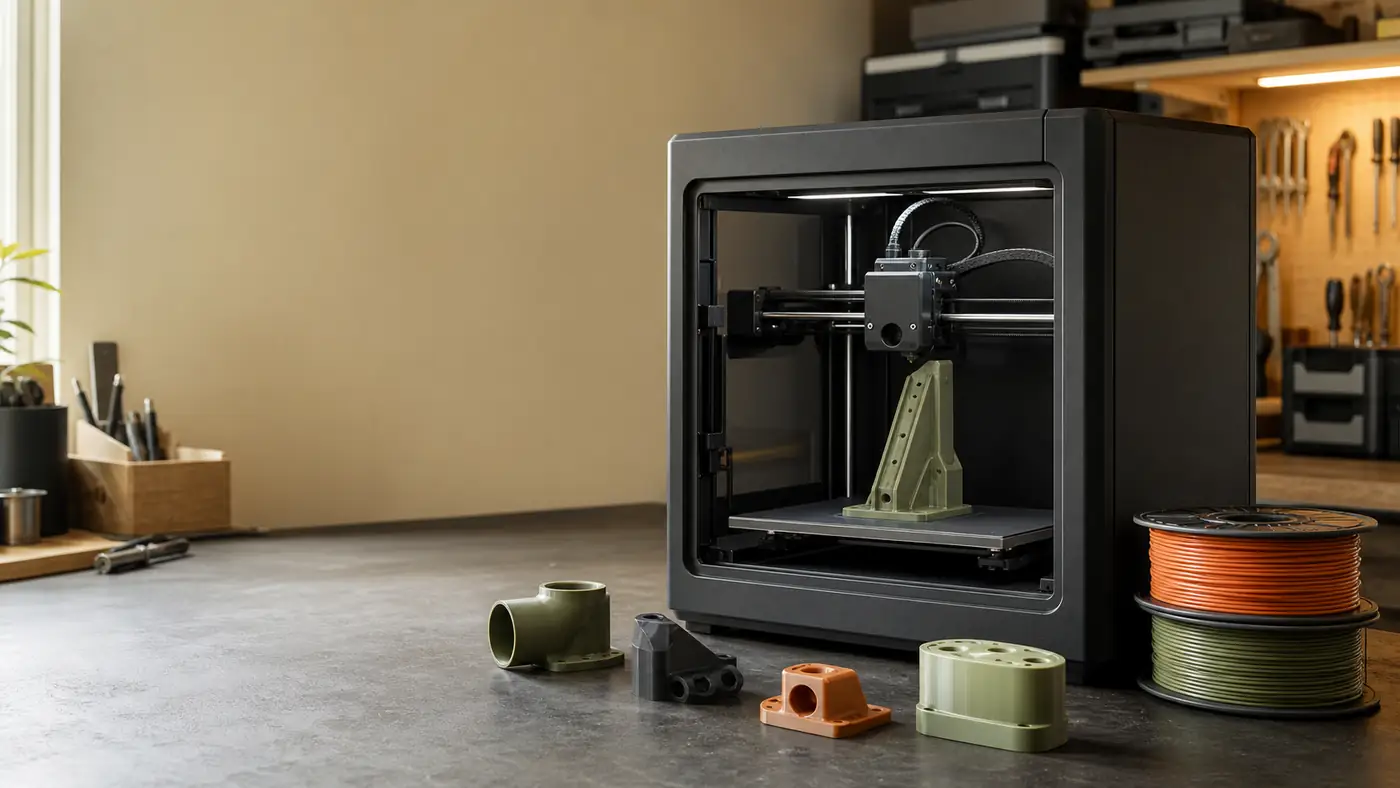
What is the best 3D printer for a small business?
"Best" means fit under load, not the loudest benchmark clip. CNET's tested 2026 list names the Bambu Lab P2S as its current frontrunner for quality, speed, and ease of use, while PCMag names the same P2S best overall for most people. Tom's Hardware's 2026 list instead crowns the Bambu Lab X2D overall and the Bambu Lab H2D as its professional pick. Those pages disagree on a trophy model because they optimize different buyer profiles.
All competitive model and feature statements in this guide were rechecked against their linked sources on 2026-08-31.
For paid work, start with the job map below. Then verify each shortlist machine against the maker's build volume, material list, and spare-parts path.
| Shop use case | Process class to shortlist | Failure cost if you pick wrong | Verify before you buy |
|---|---|---|---|
| Decor, organizers, toys, simple functional parts in common filaments | Enclosed or closable FDM workhorse | Late orders from warping, first-layer fails, or slow single-color throughput | Makers101 maps these SKUs to FDM and stresses reliability and consistency for sellers |
| Multi-color gifts or multi-material parts where purge waste hurts margin | FDM with AMS-style, dual-nozzle, or tool-changer color system | High scrap filament and babysitting on every color swap | CNET notes heavy color waste on some AMS-style paths and lower waste on Snapmaker U1 tool heads; Tom's lists Snapmaker U1 for multicolor |
| Jewelry masters, miniatures, fine-detail client prototypes | Resin / MSLA class with wash-and-cure workflow | Rejected detail, sticky post-processing bottleneck, plate after plate of fails | Phrozen separates resin for detail work such as jewelry and dental-style prototypes from FDM for faster goods (11 Oct 2024); Tom's picks Elegoo Mars 5 Ultra for ultra-high-resolution resin |
| Large props, helmets, one-piece housings | Large-format FDM | Split parts, glue lines, and extra labor when the bed is too small | Tom's names Anycubic Kobra 3 Max for large format (420 x 420 mm class bed); CNET points larger cosplay work at H2D / H2S class machines |
| Office prototypes with dual extrusion or service-bureau style jobs | Professional / office FDM (dual-extruder class) | Cross-contamination, weak support strategy, or a hobby frame in a client workflow | 3D Printers Depot groups Raise3D Pro3-class dual-extruder machines under business and office printers; a 2024 small-business video shortlist names Raise3D Pro3 Plus beside a Creality Ender-5 S1 (Savvy Professor, 25 Jun 2024) |
| Long-horizon farm with repairable parts and managed fleets | Open, serviceable FDM ecosystem | Fleet downtime when firmware, spares, or farm software are weak | Makers101 highlights Prusa Core One for print-farm integration and long-term parts support; CNET stresses Prusa's long-haul upgrade path on Core One |
If you are still learning process basics before paid volume, read 3D printers for beginners first. If the job is fine detail in photopolymer, continue in the resin 3D printer guide.
For a first purchase without a universal ranking, use the 3D printer for small business beginners guide to define the job and workspace first.
Which process fits FDM or resin for paid work?
Pick the process before the brand badge.
- Filament (FDM) for most product shops: CNET states that for almost every other application an FDM printer is the best choice for most people, citing larger build volumes and practical parts such as cosplay armor, helmets, and large-scale models. Phrozen writes that FDM suits faster mass-style consumer goods when speed and ease matter more than peak detail.
- Resin when detail is the product: Phrozen positions resin when details and precision are top priorities and calls out dental and jewelry style work that needs intricate prototypes. Makers101 maps jewelry, miniatures, and ultra-detailed items to resin. Tom's Hardware's resin picks target tiny figures and large resin batches as separate jobs.
- Handling load differs: CNET notes liquid resin is much more difficult to handle than common filament workflows. Budget wash, cure, gloves, and time in the same decision as the printer head. This page does not add chemical or disposal rules beyond that handling contrast.
- Many sellers run both later: Makers101 notes many Etsy-style sellers end up with one strong FDM and one strong resin machine. Buy the process that matches the next paid SKU, not a full fantasy catalog.
What should you lock before you open a model page?
Write these answers down. They delete whole categories.
- Ship list: name the parts you will sell or deliver, not "stuff for Etsy." Makers101 frames seller questions around daily run time, order promises, and repeatable unbox quality.
- Process: FDM or resin from the split above (Phrozen FDM vs resin guidance; CNET FDM-default note).
- Build envelope: measure the largest one-piece part and any batch layout. Phrozen treats build area as a core small-business filter for large models or multi-part plates. Tom's publishes explicit build volumes on each pick so you can check the drawing, not a demo reel.
- Chamber and materials: Makers101 lists an enclosed or closable chamber among prosumer features that cut warping on tougher filaments. Tom's notes the Prusa CORE One enclosed chamber for broader filament work. Elegoo Centauri Carbon is called fully enclosed on Tom's budget-speed pick. Match enclosure to the filaments you actually sell.
- Leveling and babysitting: Makers101 flags automatic bed leveling as a business feature because first-layer failures burn nights.
- Throughput vs success rate: Makers101 warns that a very fast printer that fails often loses to a slightly slower machine that finishes jobs.
- Spares and support: Makers101 asks how fast you can recover if a unit dies in peak season. Phrozen likewise puts customer support and community on the small-business checklist when you run more than one machine.
When those answers are stable, shortlist with the site picker instead of scrolling trophy posts. See the tested picks · Run the picker
Which machines show up on 2026 shortlists for shops?
This is a researched map of named classes, not an operator endurance test on our bench. Dates matter; refresh before you buy.
- Everyday enclosed FDM speed class: CNET's frontrunner is the Bambu Lab P2S. PCMag also picks P2S as best overall for most people (2026-06-23). Makers101 still lists Bambu Lab P1S / P2S as a budget workhorse tier for PLA and PETG style goods.
- Prosumer "just runs" FDM: Makers101 calls the Bambu Lab X1 Carbon a balanced prosumer option with an enclosed chamber and AMS multi-material support. A Reddit small-business thread snippet visible in search describes Bambu machines as easy and reliable, while calling X1 a complete no-go for that asker and A1 fine if parts are not large and tall. Treat forum notes as one operator's constraint set, not a lab rank.
- Professional / larger dual-nozzle FDM: Tom's Hardware names Bambu Lab H2D best professional with dual nozzles, larger volume, and multi-material support. CNET also covers H2D for larger items and dual-nozzle support tricks.
- Precision / open ecosystem FDM: CNET and Tom's both feature Prusa CORE One as a CoreXY accuracy-focused enclosed machine. Makers101 stresses Core One for farm tools and repairability.
- Budget enclosed speed FDM: Tom's picks Elegoo Centauri Carbon as a fully enclosed, pre-assembled speed option. CNET calls Centauri Carbon a budget workhorse for stable long use.
- Compact color entry FDM: PCMag lists Bambu Lab A1 mini among multicolor-capable picks. CNET warns the A1 Mini build area is small by design, which matches the Reddit size caveat above.
- Resin detail class: Phrozen promotes its Sonic Mega 8K S and Sonic Mega 8K V2 for small-business resin volume (maker page, 11 Oct 2024). PCMag's pro resin pick is Formlabs Form 4. Makers101 also treats Form 4 as a professional resin benchmark and Elegoo Saturn 4 Ultra as a high-volume mini/jewelry plate option.
- Office dual-extruder class: 3D Printers Depot's business collection features Raise3D Pro3 family dual-extruder machines for workplace prototyping. The Savvy Professor small-business video (25 Jun 2024) names Raise3D Pro3 Plus and Creality Ender-5 S1 in its walkthrough.
- Dated 2025 business editorial: All3DP's small-business roundup, updated 21 Jan 2025, frames easy, reliable office-oriented machines for 2025 buyers. Re-check live model names on that page before you treat any 2025 line as current stock.
- Video explainers in the SERP: TechInspct's small-business printer video (28 Sep 2025) and the Savvy Professor video above are discovery posts, not substitutes for a written spec check.
Dollar stickers move with bundles and stock, so this page does not restate prices. Compare live listings only after the job map is fixed.
What do professionals and reliable brands actually mean here?
Search often asks for "the most reliable brand" or "what professionals use." Editorial evidence points to roles, not a forever crown.
- Reliability as uptime: Makers101 defines the seller problem as minimal babysitting, fewer failed prints, and the same quality day after day. That is an operations metric, not a logo contest.
- Brand clusters in 2026 tests: Bambu Lab appears across CNET, PCMag, Tom's Hardware, and Makers101 for fast enclosed FDM. Prusa appears when accuracy, open parts, and farm software matter (CNET on Core One; Makers101 on farm integration). Raise3D shows up in office/business reseller catalogs and older video shortlists. Resin brands split between maker volume lines (Phrozen Mega series; Elegoo / Anycubic in Tom's and Makers101) and studio ecosystems (Form 4 in PCMag and Makers101).
- Professional means the workflow you must not break: dual extrusion and office prototyping (Depot business framing), farm repairability (Makers101 on Prusa), or studio resin workflows (Form 4 positioning in PCMag). Pick the professional trait you will pay downtime to protect.
When is a 3D printer the wrong next machine?
A printer is wrong when the part should be cut, not stacked in layers.
- Need pockets, thick 3D machining, or contact cutting in stock a plastic bead cannot replace? Compare a desktop CNC mill.
- Need flat profile cutting or surface marking in sheet goods? Compare a desktop laser cutter.
- Still validating whether anyone wants the object before you buy hardware? Route a one-off through prototyping or commissions instead of forcing a printer purchase.
How should a small shop decide in one pass?
Use this order. Skip steps only if that row in the job table is already proven in your orders.
- Write the SKU list and the cost of a failed overnight run (Makers101 seller framing).
- Choose FDM or resin from product detail and handling load (Phrozen; CNET).
- Size the bed to the largest part or batch plate (Phrozen build-area guidance; Tom's published volumes).
- Require enclosure, leveling, and spares path that match your materials and peak season (Makers101 feature list).
- Only then compare named machines on editorial shortlists (CNET; PCMag 2026-06-23; Tom's; Makers101).
Profit claims and licensing rules for selling prints are local, product-specific, and not settled by printer marketing pages in this source set, so they stay off this article. Design rights and sales rules need their own counsel; the machine choice does not answer them.
When the workflow and failure-cost answers are written, shortlist on the picker. See the tested picks · Run the picker
The machine that earns its bench is the one whose process, bed, and uptime match the parts you already know how to sell. Start there, then compare models.
Written by Tileo, operator of Make At Home.