Portable laser buyer gate
Portable laser engraver: qualify the worksite before the machine
What is the short answer?
A portable laser engraver is portable when you can move it, but that does not make it ready for a worksite. Before comparing models, pass one written evidence gate for the exact machine, exact material, controls and extraction, worksite, supervision, and documentation. Keep the exact manual and label, written material compatibility and current SDS, required controls, site permission, and stop instructions in the file. OSHA describes laser classification, engineering controls, administrative controls, and ventilation. This gate organizes evidence. It does not certify a machine or site. OSHA Technical Manual, Section III, Chapter 6.
Our editorial verdict: we would not shortlist a portable laser until the machine, material and worksite pass one written gate. We have not tested or owned the products named below. This is a document check, not a product ranking.
Safety and product references checked 20 September 2026.
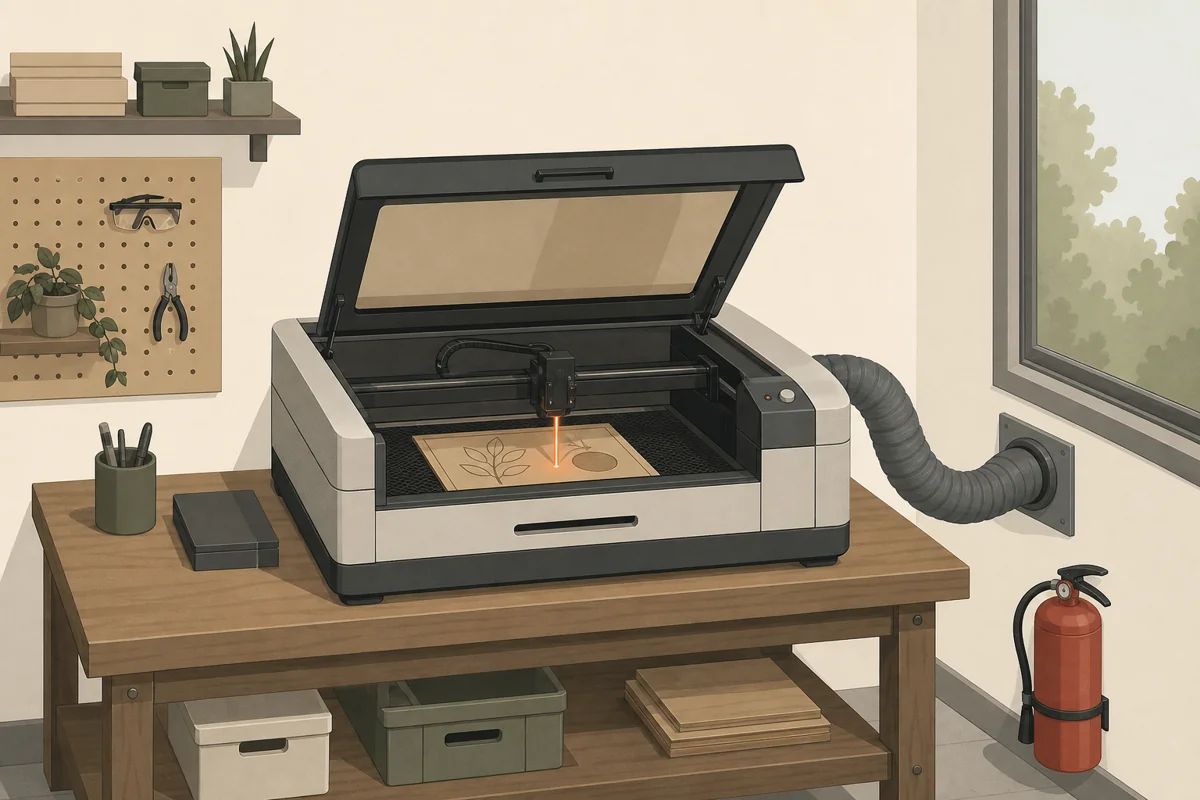
Why is "portable" only a transport claim?
"Portable" tells you that a seller intends the machine to move. It does not answer what happens after it arrives. The operating question is whether the exact machine, material and room form a controlled setup. OSHA says laser hazard classification warns users through labels and instructions, and notes that a classification may change when a system is modified. That is why a listing headline cannot replace the exact label or manual. OSHA OTM: laser hazard classifications.
Moving the machine also changes the site evidence. The extraction route, access boundary, stable surface, available services and permission must be known for the new place. Berkeley Lab’s laser-safety resource points readers to engineering controls, administrative controls and training. It does not certify a consumer product, but it supports treating the workspace and operating rules as part of the decision. Berkeley Lab EHS: Laser Safety Website.
Use one site card for each place. Put the address or room name at the top. Add the exact machine and stock below it. Then mark each gate as proved, open, or stopped. "Proved" means the document in your file answers the row. "Open" means the machine stays off while you seek an answer. "Stopped" means the present plan cannot continue. Do not carry a pass from one site to another. This simple record keeps a compact machine from becoming a vague setup. It also makes a later change visible. If the room, stock, machine configuration, or operator plan changes, update the card and run the gate again.
What must pass the worksite-readiness gate?
| Gate | Evidence before comparison | Stop condition |
|---|---|---|
| Machine identity | Exact model, label and manual. Classification uses labels and instruction to communicate hazards. OSHA OTM. | The exact label or manual is missing. |
| Material | Written compatibility for the exact operation and the current SDS. | Stock is unknown, composite, coated or treated and written support is absent. |
| Beam and access controls | The manual’s enclosure, interlock and access-control arrangement stays intact. OSHA lists protective-housing interlocks among control measures. OSHA OTM: control measures. | A control must be removed, defeated or bypassed. |
| Air and site services | A documented extraction route and the exact manual’s power or cooling requirements, where applicable. OSHA calls for adequate ventilation for potentially hazardous fumes and vapors from laser processing. OSHA OTM: ventilation. | The required control or service has no evidence. |
| Operating place | Stable work surface, location permission, supervision, and exact emergency and stop instructions. | The plan is unattended or the location is not approved. |
Which current examples have official-page support?
The eligible official pages support only the limited facts shown in their linked rows. Each example receives the same columns and no rank. Any supplied item without a working page and exact support is omitted rather than reconstructed.
| Current example | Exact official-page facts | Evidence still required |
|---|---|---|
| LaserPecker LP5 Verified 20 September 2026 | The official page describes a dual-laser engraver with a 20 W fiber laser, a 20 W diode laser and a stated maximum speed of 10,000 mm/s. LaserPecker LP5 official page. | Exact label/manual, written material and SDS match, complete controls, extraction route, site services, stable surface, supervision, stop instructions and location permission. |
| Gweike G2 Verified 20 September 2026 | The official page names the product "G2 20W Metal & Plastic Fiber Laser Engraver" and lists "Manual Lift" and "Electric Lift" variants with a "Safety Shield." Gweike G2 official page. | Exact label/manual, written material and SDS match, complete controls, extraction route, site services, stable surface, supervision, stop instructions and location permission. |
The vendor facts show why the gate comes first. Different named sources and configurations are not interchangeable, so the product page for one model cannot close an evidence row for another. This table does not say either setup is safe, suitable or better.
What evidence and ownership costs belong in the file?
| File section | Evidence to retain | Ownership-cost line, without a price claim |
|---|---|---|
| Machine | Exact model, label, manual, included configuration and service route. | Machine, required controls, approved accessories and replacement path. |
| Material | Written compatibility, exact operation and current SDS. | Qualified stock, rejected stock, samples and handling route. |
| Worksite | Permission, stable surface, access plan, extraction route and required services. | Site preparation, control equipment and any approved service work. |
| Operation | Training record, supervision plan, emergency/stop instructions and maintenance documents. Berkeley Lab points to engineering controls, administrative controls and training as laser-safety topics. Berkeley Lab EHS. | Operator time, training, documented maintenance, consumables and service. |
Give each file a clear owner. That person does not have to guess. The job is to keep the set whole and up to date. Put the model name on each page. Add the source link and the date you read it. If a new file replaces an old one, keep the change clear. A saved sales page is not the same as the manual. A chat note is not the same as written support for the exact stock. Use plain names so the next user can find the proof fast.
Treat each gap as work. Write who will close it and what proof is due. The machine stays off while a hard row is open. This avoids a weak chain of guesses. It also stops one broad claim from filling many rows. A seller may answer a product fact. A stock maker may answer a stock fact. The site owner may give or deny use of the room. Keep each answer with the row it can support.
Plan the move on paper. List what travels with the unit. List what stays at the site. Then check the full set at both ends. The aim is not a long form. It is a clear yes or no for each gate. If a part of the plan can be lost in transit, mark that risk. If a site has a new layout, do not reuse the old map. Make a fresh card for the real room.
Keep the buyer test apart from the use test. The buyer test asks if the proof is good enough to compare. It does not grant the right to run the tool. Use can start only under the exact manual and the plan for that site. This split helps with sales copy. A claim may be enough to ask a new question, yet too weak to close a gate. That is fine. Mark it open and seek the source.
At the end, read the file as if you had not built it. Can you name the unit, stock, task, room, controls and person in charge? Can you find the stop steps? Can you show that the site has said yes? If not, the file is not done. Do not fix it with a score. A score can hide one hard stop. This gate keeps hard stops in view and sends the plan back for proof.
Do not fill the cost file with a universal payback estimate. The purpose is to expose every required line before a machine price dominates the decision. A blank required line is a gap, not zero cost.
How should you build a portable-laser brief?
Start with the job and location, then ask the seller for exact-model evidence. Keep these action items together:
- Name the exact stock, coating or treatment, the intended operation, written compatibility and current SDS. OSHA treats material-processing fumes and vapors as a possible nonbeam hazard. OSHA OTM.
- Record the exact machine label, manual, enclosure, interlocks and access controls. OSHA links classification to labels and instruction and lists interlocks among engineering controls. OSHA OTM.
- Document the extraction route and the manual’s power or cooling requirements where applicable. Do not invent airflow, duct, electrical or cooling specifications.
- Confirm a stable surface, location permission, supervision and the exact emergency and stop instructions before operation.
Which assumptions should you reject?
- Reject "small means harmless." OSHA's framework bases laser classes on accessible radiation and uses labels and instructions to warn users; size is not the stated basis. OSHA OTM: classifications.
- Reject "a shield closes the case." Protective housing, interlocks, area controls and administrative controls are separate parts of OSHA's control discussion. OSHA OTM: control measures.
- Reject "visible smoke is the whole fume test." OSHA discusses noxious or potentially hazardous fumes and vapors and calls for adequate ventilation. OSHA OTM: nonbeam hazards.
- Reject "portable means unattended." This guide sets active supervision as a hard gate; follow the exact machine's instructions and the competent local assessment.
What is the best portable laser engraver?
There is no universal winner. First pass one written gate for the exact machine, exact material, controls and extraction, worksite, supervision, and documentation. The gate does not certify a machine or site. After it passes, compare only candidates whose official pages and exact manuals support your planned job. We have not tested or owned the products named on this page.
Are cheap laser engravers worth it for beginners?
Price and a beginner label do not settle the decision. Compare a lower-cost candidate only after the same written gate passes. If its exact manual, material support, controls, extraction plan, worksite evidence, supervision plan, or documentation is missing, close the gap before buying. Unknown compatibility is a stop.
Is a portable laser engraver worth buying?
It can enter comparison only when you can move the whole controlled plan, not only the machine. If the required documentation, material approval, or worksite evidence is missing, close the gap first. There is no universal winner or payback claim here.
What are the disadvantages of a portable laser engraver?
Every planned location needs its own permission and operating evidence. Preserve the exact controls during transport and setup, retain the correct documents, and reject a site that cannot support the manual's requirements. Those are decision burdens, not a ranked product defect.
What material cannot be engraved?
There is no universal list in this guide. Unknown, composite, coated, or treated stock without written compatibility for the exact machine and operation plus a current SDS is a stop. OSHA notes that laser processing can create noxious or potentially hazardous fumes and vapors, so a material photo or broad category is not enough. Source: OSHA Technical Manual, Section III, Chapter 6.
Are laser engraving fumes safe?
Do not assume that they are. OSHA says adequate ventilation should reduce noxious or potentially hazardous fumes and vapors from laser welding, cutting, and other target interactions. That supports requiring a documented control route, not copying a generic airflow number. The exact material, machine manual, and competent local assessment govern. Source: OSHA Technical Manual, Section III, Chapter 6.
Where should you compare next?
Use the diode laser engraver guide for that process, the desktop laser cutter guide for a fixed-workshop route, and the laser buying planner to record the evidence. Then review all laser machine categories.
Written by Tileo, operator of Make At Home.