RESEARCHED BUYING GUIDE · 1 OCTOBER 2026
Best CO2 laser cutter for small business: write the requirements first
Short answer: The best CO2 laser cutter is the one whose current documents match your named materials, room and work queue. Require a complete ventilation route because OSHA says adequate ventilation shall be installed to reduce noxious or potentially hazardous fumes and vapors from laser cutting and other target interactions below the appropriate threshold limit values (OSHA Technical Manual). Check the machine classification and planned use before selecting controls because OSHA bases laser control measures on the laser class and use (OSHA Technical Manual). If the seller cannot document those requirements for the exact configuration, leave that machine off the shortlist.
Written by Tileo, operator of Make At Home.
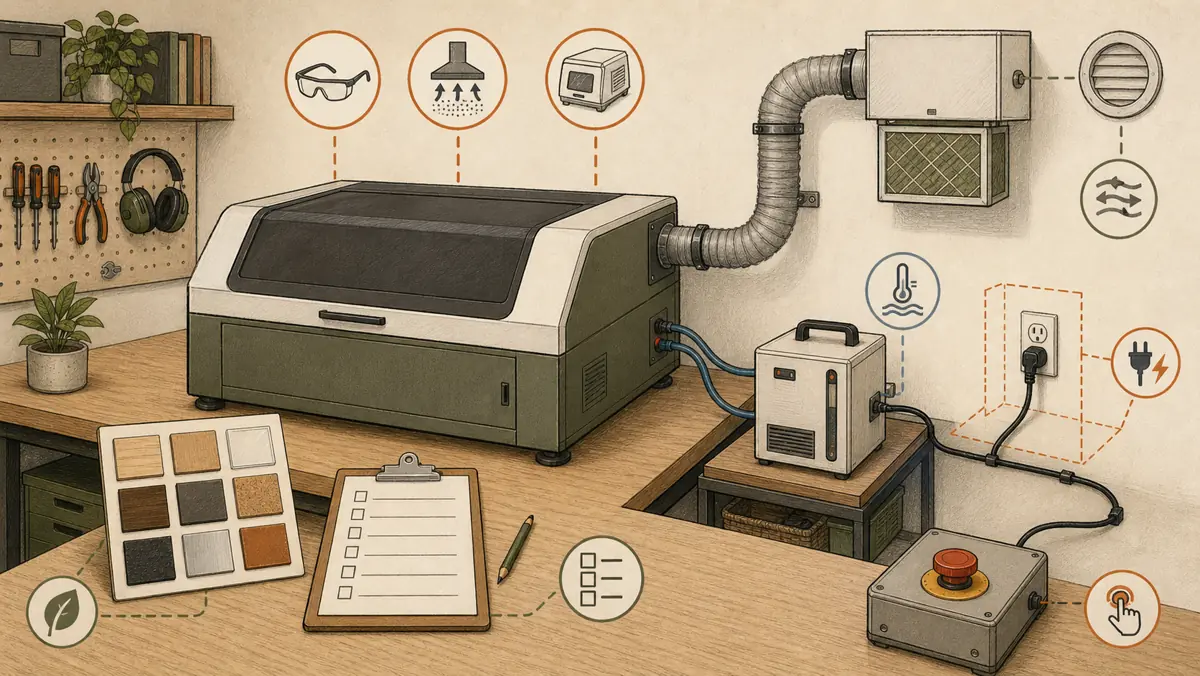
Which CO2 laser machine is best?
No named machine is best before the job is defined. Use one requirements sheet for every candidate. A seller answer counts only when it refers to the exact configuration you may buy.
| Requirement | What to record | Evidence needed before shortlisting |
|---|---|---|
| Materials | Exact stock, finish, treatment and planned cut or engraving | Current machine guidance for that material and operation. OSHA says laser cutting and other target interactions can produce noxious or potentially hazardous fumes and vapors (OSHA Technical Manual). |
| Ventilation | The complete route from the machine to its discharge point | A design that meets the machine requirements and the OSHA wording on adequate ventilation for fumes and vapors from laser cutting (OSHA Technical Manual). |
| Fire controls | The controls and response specified for the exact machine and use | Current manufacturer instructions. OSHA identifies some laser systems as potential fire hazards and says significant controls are required for Class IV laser facilities (OSHA Technical Manual). |
| Electrical fit | The machine requirements and the actual workshop supply | A site decision based on the exact machine documentation. OSHA includes electrical hazards among the associated laser hazards (OSHA Technical Manual). |
| Workspace | Machine footprint, stock movement, operator position and service access | A measured layout checked against the current manual. |
| Production queue | Named jobs, order sequence, changeovers and acceptance checks | A representative workflow demonstrated on the quoted configuration. |
Do not convert a missing answer into a score. Mark it open. The CO2 workshop-readiness gate gives you a detailed evidence file, while the laser buying planner keeps the requirements together.
Use the sheet as a set of Make At Home buying questions. Put the seller's answer beside your own workshop answer. Then name the document, person or sample that supports it. A blank field is not a weak score. It is a reason to pause the purchase.
- Can you give us a full material inventory? List each stock item as you buy it. Include the supplier name, product name, grade, finish, coating, treatment and thickness when known. Add the planned cut or engraving. Ask the seller to point to current guidance for each exact item. Keep a separate row for any material whose identity is not clear.
- Which materials must stay out of the machine? Ask the seller to name every excluded material, finish, coating and treatment in writing. Add those exclusions to the job intake sheet. Do not treat silence as approval. OSHA says laser cutting and other target interactions can produce noxious or potentially hazardous fumes and vapors (OSHA Technical Manual).
- Can you draw the whole ventilation path? Mark the machine outlet on the room plan. Mark each duct section. Mark the final discharge point. Record the machine document that supports the design. Note who must approve the site plan. OSHA says adequate ventilation shall reduce noxious or potentially hazardous fumes and vapors below the appropriate threshold limit values (OSHA Technical Manual).
- Who keeps the fire watch? Name the person who watches the work. Name the person who can stop it. Ask which machine rules govern that role. Ask what to do when a problem occurs. Put those rules on the same record. OSHA identifies some laser systems as potential fire hazards and says Class IV laser facilities require significant controls (OSHA Technical Manual).
- Does the machine placement work on paper? Draw the machine at its measured size. Draw the stock path. Mark the operator place and service access. Add the planned supply point. Compare that plan with the exact machine documents. Do not fill an electrical field from a photo or a similar model. OSHA includes electrical hazards among the hazards linked to laser systems (OSHA Technical Manual).
- Will the seller support a supervised sample test? Use stock from the inventory. Name the result that you will accept. Record the exact machine setup before the test. Name the supervisor. Name the person who accepts the sample. Stop if the stock or setup changes. Berkeley Lab groups laser safety information under engineering controls, administrative controls and training (Berkeley Lab EHS).
- How will we record a reject? Give each failed sample a job reference. Note the stock identity, requested result and reason for rejection. Keep the record with the accepted sample record. A reject is evidence about that job and setup. It is not proof about another material or another machine. Ask who can close the reject and what evidence that person needs.
- Who owns maintenance after handover? Put one role beside each task named in the machine documents. Record where that person logs the work. Record where replacement records live. Ask who checks the ventilation parts named by the maker. OSHA requires adequate ventilation for the fumes and vapors covered by its laser guidance (OSHA Technical Manual).
- What closes the job and returns the machine? Write a shutdown and handback check for the quoted setup. Name who stops the job. Name who clears the work record. Name who returns the machine to its agreed state. Keep open rejects and maintenance needs visible at handback. Berkeley Lab includes engineering controls, administrative controls and training in its laser-safety information (Berkeley Lab EHS).
What is the best laser cutter in 2026?
A year in the title does not settle the choice. For this guide, “best in 2026” means that the evidence is current on 1 October 2026 and applies to the configuration under review. It does not mean that a ranked model stays best after its documentation, your stock or your room changes.
Review each candidate in this order:
- Lock the named material and operation.
- Match the current machine documents to that job.
- Close the ventilation, fire-control and electrical fields with source-backed requirements. OSHA addresses fumes and vapors, fire hazards and electrical hazards in its laser guidance (OSHA Technical Manual).
- Lay out the actual workspace and production queue.
- Reject the candidate if a required field remains unsupported.
The picker helps structure material, space and machine questions.
What is the most profitable engraving?
This guide cannot name one. Profit depends on your selling price, material, rejected work, operator time and queue, none of which a general search result can verify. Do not let an example product become a forecast.
Use a job card instead:
- Name the item and the exact stock.
- Define the accepted cut or engraving.
- Record every step that occupies the machine or the operator.
- Place the job in the real queue, including changeovers.
- Keep revenue and margin estimates in your own current records.
Is a CO2 laser engraver worth it?
It is worth shortlisting only when the machine fits the documented job, room and queue. This is a buying gate, not a return claim. Berkeley Lab says its laser-safety information covers engineering controls, administrative controls and training for work with laser systems (Berkeley Lab EHS). Record the applicable controls and training evidence for the exact setup (Berkeley Lab EHS).
Choose among these routes without forcing a purchase:
- Compare machines: all requirements have current evidence.
- Revise the workshop: the job is defined, but the room does not yet fit the documented requirements.
- Use a service: the job exists, but owning the process does not fit the present queue or workspace.
- Stop: the material or a required safety field remains unknown. OSHA addresses fumes and vapors, fire hazards and electrical hazards in its laser guidance (OSHA Technical Manual).
What is the downside of a CO2 laser?
The downside is the set of unresolved requirements around the machine. OSHA says adequate ventilation shall be installed for noxious or potentially hazardous fumes and vapors produced by laser cutting and other target interactions (OSHA Technical Manual). OSHA also addresses fire and electrical hazards associated with laser systems (OSHA Technical Manual). Berkeley Lab groups laser-safety information under engineering controls, administrative controls and training (Berkeley Lab EHS).
That leaves a practical test. If the ventilation route, fire controls, electrical fit or operator rules cannot be documented for the exact setup, the workshop is not ready to compare that candidate (OSHA Technical Manual; Berkeley Lab EHS).
What is the best CO2 laser engraver?
The best engraver is the candidate that clears the same requirements table without special pleading. Do not rank names first. Ask each seller for the same material, ventilation, fire-control, electrical, workspace and queue evidence. Give the candidates equal treatment, then remove any machine whose required evidence stays open.
This page makes no first-hand test claim and gives no vendor ranking. For a wider process comparison, read the small-business laser cutter guide. For the final choice, use the machine documents and a competent assessment for the actual site.
Take the named material, measured room and real queue into the picker.